
FOR NEW TEAM LEADERS WITH TOO MUCH ON THEIR PLATE
A clearer plan.
A more manageable week.
Your own work. Your team’s questions. Another “quick” request. Make the load visible, decide what matters and know what to say when it won’t all fit.
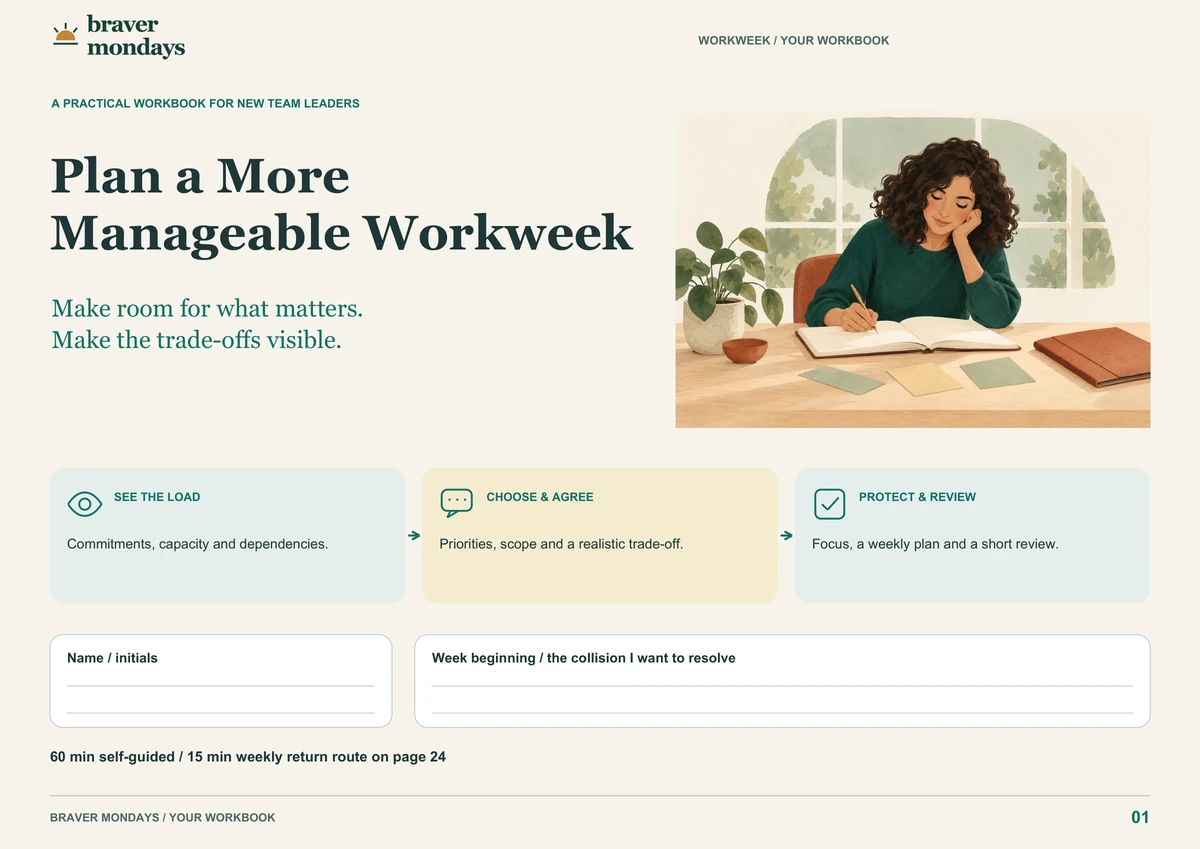
Plan a More Manageable Workweek
Self-guided PDF workbook · About 60 minutes working independently · Reuse every week

FINISH WITH SOMETHING YOU CAN USE ON MONDAY
Your weekly plan, a capacity map and words for a workload discussion.
FROM CARRYING IT ALL IN YOUR HEAD
“I can see what fits.
And I know what
needs to change.”
Being dependable doesn’t mean saying yes before checking your week.
- See your own work and your team’s needs in one place
- Choose a few outcomes with clear reasons and realistic time
- Protect focus while keeping a route open for urgent support
- Explain the gap and offer a choice someone can act on
A plan cannot make impossible demand disappear. It can help you make the decisions visible and agree changes earlier.
TRY A SMALL PART OF THE WORKBOOK
The week won’t get bigger.
The plan can change.
Meet Alex. After meetings, team support and contingency, there are 15 hours left for deliverables. The requests add up to 25 hours.
Try three changes Alex could agree. See what happens to the gap.
Fictional worked example. Changes need agreement; handing work over requires someone with the skills and capacity.
ALEX’S DELIVERY TIME
The line marks the 15 hours available.
In the workbook, you’ll build this picture for your own week.
REAL PAGES. ROOM FOR YOUR REAL WEEK.
Less mental juggling.
More clarity on paper.
Work through visual exercises, a fully worked example and three practice cases. Finish with one page you can return to throughout the week.
ONE HOUR TO BUILD YOUR FIRST PLAN
See the load.
Agree the choices.
Start with a plan.
Work independently in about 60 minutes.
Use the 15-minute return route each week.
- 01
Get the whole week in view
Capture commitments, estimate capacity and choose outcomes with a clear definition of done.
- 02
Make room for what matters
Build focus and support time into the week. Practise a conversation about scope, timing or ownership.
- 03
Keep the plan honest
Check new requests, review midweek and close Friday knowing what to carry forward or renegotiate.
A CALMER WAY TO TALK ABOUT THE LOAD
“I have 15 hours available and 25 hours of work requested. Here are three changes that could make it fit. Which trade-off should we agree?”
You’ll write your own version, rehearse the response and record who agreed to what.
INSIDE THE FULL WORKBOOK
A realistic plan. Words for the trade-off.
Plan a More Manageable Workweek
- 01
See what actually fits
Map commitments, meetings and support time. Use a worked example to estimate the hours left for deliverables.
- 02
Practise asking for a decision
Choose realistic priorities and rehearse a workload discussion. Bring options for scope, timing or ownership.
- 03
Use the plan through the week
Keep priorities and agreements on one page. Check new requests, review midweek and close Friday with a clear next step.
A guide to work through it
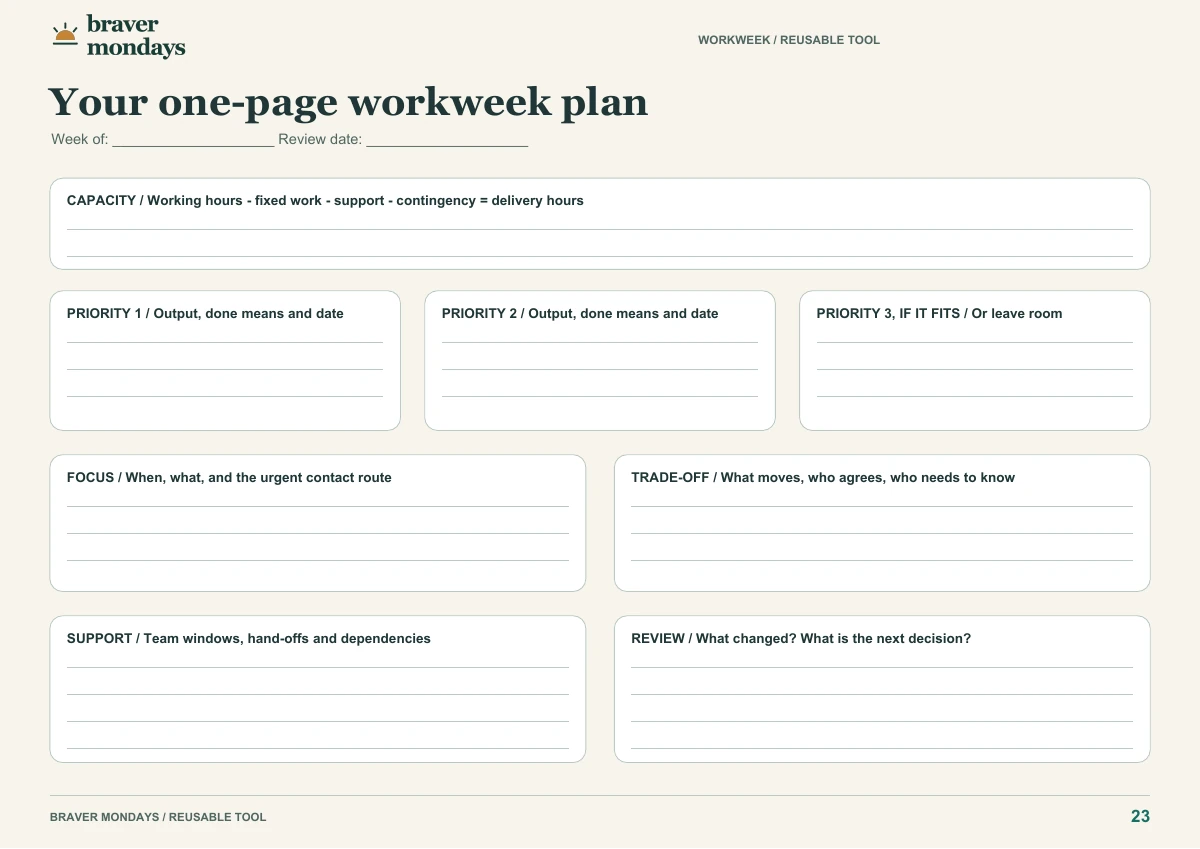
Your 24-page visual workbook comes with a 12-page companion guide: teaching explanations, practice guidance and an optional 90-minute plan for practising with a group.
ONE COMPLETE WORKBOOK
Free sampleFull workbook in development
Bring one real situation.
Work through it at your pace.
- Two printable PDFs to keep and reuse
- About 60 minutes working independently on your first pass
- 15-minute weekly return route
No payment now. Joining is not an order.
BEFORE YOU BEGIN
A few useful
details.
What does the workbook add to a template?
You work through explanations and a realistic example, make decisions for your own situation, rehearse the conversation and check your approach against the guidance. The reusable worksheet brings those decisions together.
Who is this workbook for?
New team leaders balancing their own deliverables with meetings, team questions and incoming requests. Use your actual week or the fictional examples if you prefer.
How is this different from a weekly planner?
You will practise the decisions behind the plan: estimate capacity, choose priorities, negotiate a change and check the impact on other people. The planner is the final reusable output.
What if I cannot change the workload myself?
The exercises help you distinguish what you can decide from what needs agreement. You will prepare a capacity estimate, options and a specific question for the person who can change scope, timing, ownership or resources. The workbook cannot guarantee their agreement.
Is it a video course or live session?
No. It is a self-guided workbook: two printable PDFs you keep, with no videos or live sessions. Allow about 60 minutes on your own. The companion guide also includes an optional 90-minute plan if you want to practise with a group or a partner.
Do I need another workbook first?
No. This workbook includes its own workload discussion structure and practice cases. Prepare Your Next Difficult Conversation is a separate option for deeper preparation for everyday conversations.
Can I type into the workbook?
These are printable PDFs with writing space, not interactive form fields. Print them, use your PDF annotation tool, or write your answers separately. No workplace information needs to be uploaded.
Can I buy it now?
We’re collecting interest before opening sales. Request 3 free samples, or join the launch waitlist for the workbook you want. No payment is collected and joining is not a pre-order.
A LITTLE PREPARATION. A BRAVER WORKING WEEK.
Start Monday with
a clearer way forward.
Know what matters. See what fits.
Bring the trade-offs into the conversation.