
PRACTICAL WORKBOOKS FOR NEW TEAM LEADERS
Find your words.
Feel ready to lead.
That conversation you keep putting off? Prepare what to say, how to listen, and where to go next.
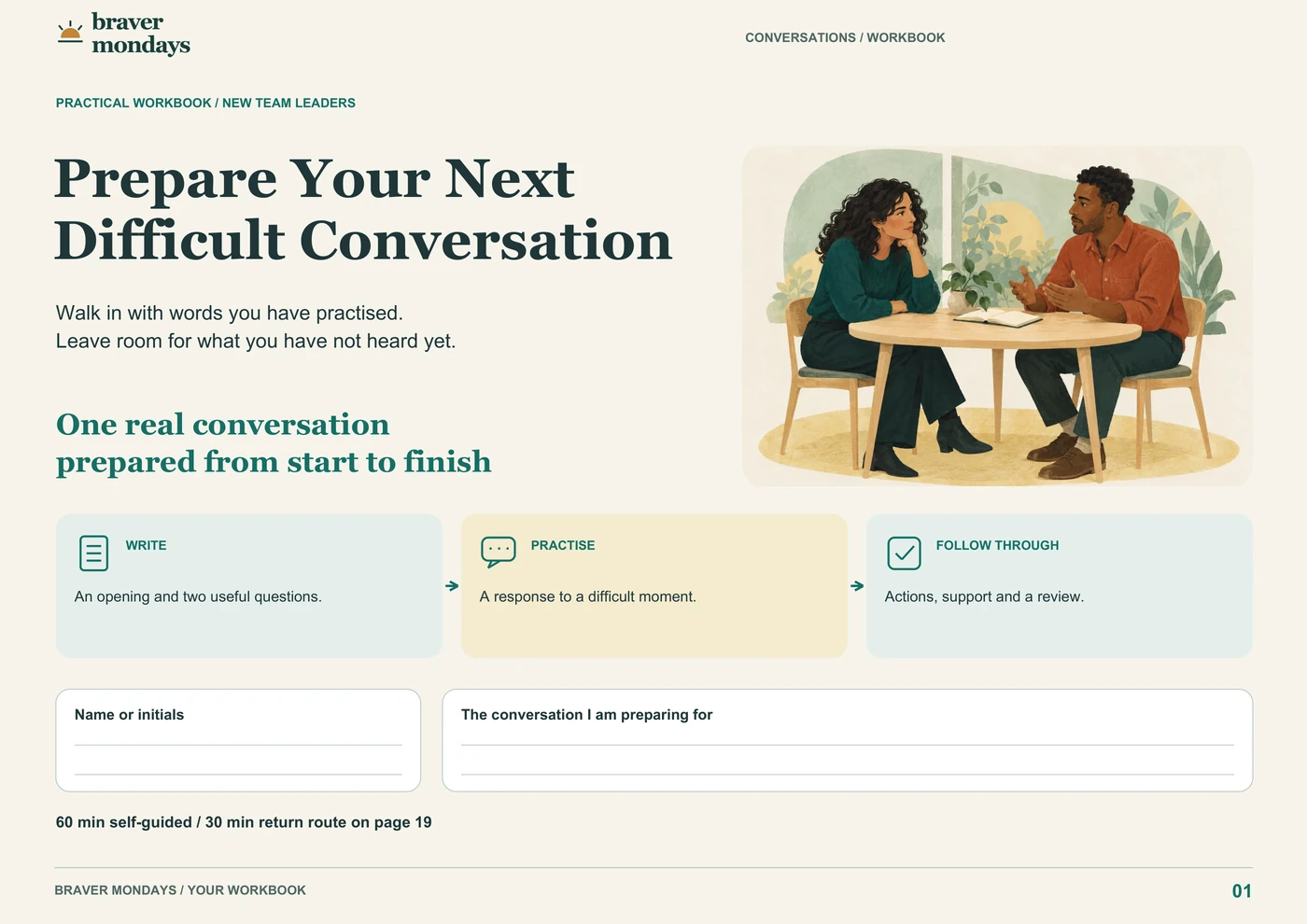
Prepare Your Next Difficult Conversation
A self-guided PDF workbook · About 60 minutes working independently · Yours to reuse

A SMALL WORKBOOK. SOMETHING REAL TO TAKE WITH YOU.
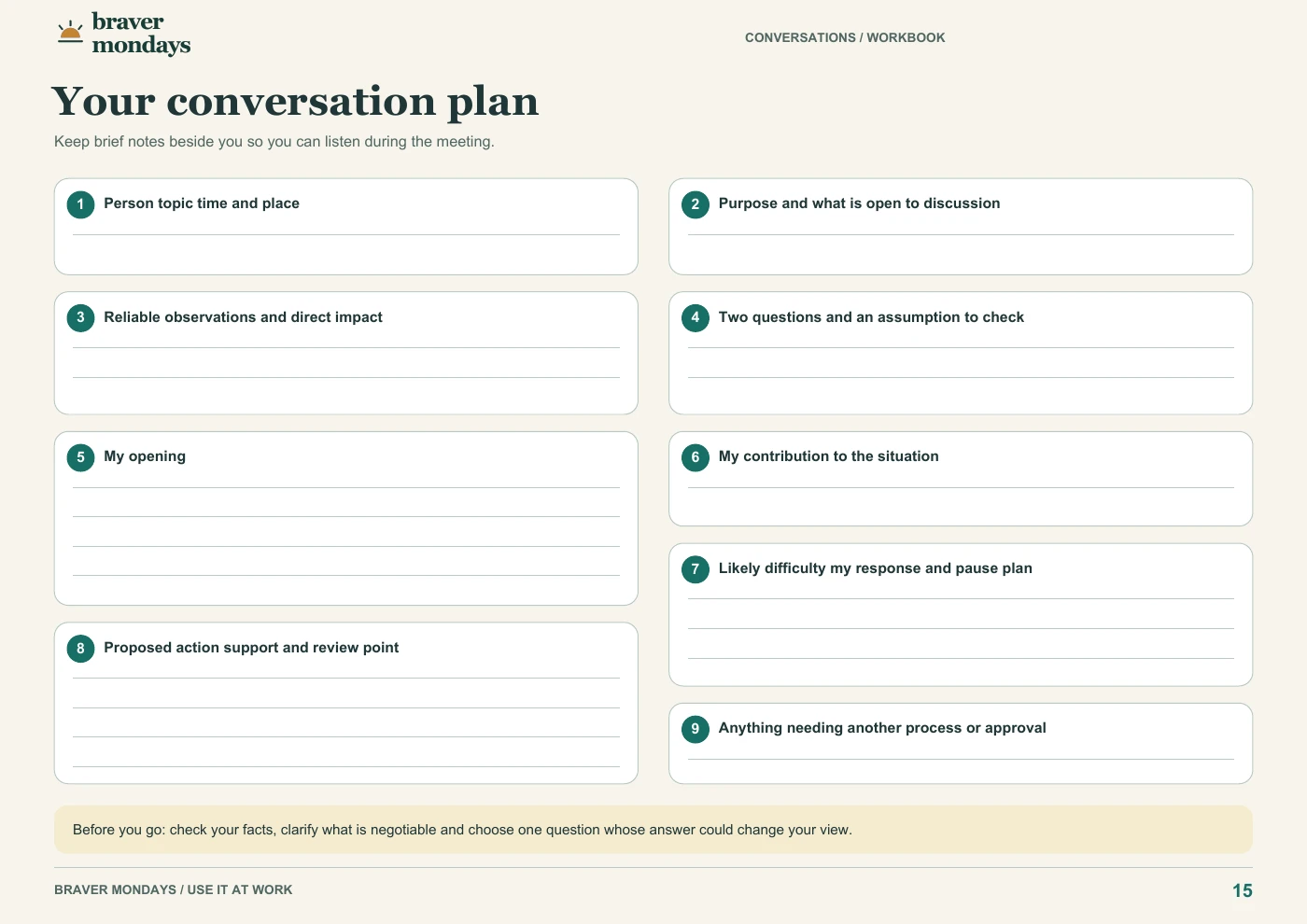
Your opening written. A difficult response rehearsed. A one-page plan ready to take with you.
YOU WANT TO BE FAIR. YOU ALSO NEED TO BE CLEAR.
What’s the conversation
on your mind?
Choose a familiar moment. See how a little preparation gives you somewhere to start.
THE THOUGHT GOING ROUND IN YOUR HEAD
“How do I bring this up without sounding harsh?”
- Say it clearly
- “The brief arrived a day after we agreed, so I moved the review.”
- Make room to listen
- “What affected the timing from your side?”
- Know what to work toward
- Agree a realistic hand-off and when to flag a delay.
Illustrative example · You’ll build a plan for your own situation.
LESS REHEARSING IN YOUR HEAD. MORE CLARITY ON PAPER.
Picture yourself
walking in prepared.
See exactly what you’ll use: simple visual exercises that turn a difficult situation into words, questions and a plan.
TRY ONE SMALL SHIFT, RIGHT HERE
The first sentence
can feel the hardest.
Give yourself a way in. Explore four parts of an opening you can adapt to sound like you.
THE SUPPLIER HAND-OFF · FICTIONAL EXAMPLE
“I’d like us to make our next hand-off more predictable. We agreed Tuesday at 2 pm; the brief arrived Wednesday at 11 am. I moved the review, and the next task started a day later. What affected the timing from your side?”
Name what you want to work on together. Make the purpose clear before discussing the detail.
THE FEELING YOU’RE WORKING TOWARD
“I know what I need
to say. And I’m ready
to listen.”
You don’t need a perfect script. You need a clear starting point and something to return to when the conversation gets difficult.
- Say what matters without guessing at someone’s motives
- Listen with two questions you’ve thought through
- Have a response ready for disagreement or defensiveness
- Work toward clear actions, support and a follow-up date
Preparation can’t control someone else’s reaction. It gives you something steadier to bring to the conversation.
ONE CONVERSATION · THREE STEPS
Prepare independently.
One real conversation.
A clearer way in.
About 60 minutes working independently on your first pass.
Return to the 30-minute route next time.
- 01
Get it out of your head
Separate facts from assumptions. Notice your reactions and choose a fair setting.
- 02
Find words that sound like you
Draft your opening, try a response to disagreement, then repeat one improved sentence aloud.
- 03
Bring your plan into the room
Use your one-page plan, send a clear follow-up and reflect on what changed.
INSIDE THE FULL WORKBOOK
An opening you can say. A plan you can return to.
Prepare Your Next Difficult Conversation
- 01
Write your own opening
Separate what happened from what you assumed. Build an opening that names the issue and invites another view.
- 02
Practise the difficult moment
Use three fictional cases, response options and an observer checklist. Try your words, change one sentence and repeat it.
- 03
Take a plan into the conversation
Keep your opening, questions and next step on one page. Use the follow-up prompts and return route next time.
A guide to work through it
Your 20-page visual workbook comes with a 11-page companion guide: teaching explanations, practice guidance and an optional 90-minute plan for practising with a group.
ONE COMPLETE WORKBOOK
Free sampleFull workbook in development
Bring one real situation.
Work through it at your pace.
- Two printable PDFs to keep and reuse
- About 60 minutes working independently on your first pass
- 30-minute preparation route
No payment now. Joining is not an order.
A FEW THINGS TO KNOW
Before you
begin.
What does the workbook add to a template?
You work through explanations and a realistic example, make decisions for your own situation, rehearse the conversation and check your approach against the guidance. The reusable worksheet brings those decisions together.
Is this right for a first-time team leader?
Yes. It is designed for people in their first two years of team leadership, including people managing former peers. Choose an everyday situation such as a missed commitment, interruptions or competing priorities.
Is this a video course or a live session?
It is a self-guided workbook delivered as printable PDFs. There are no video lessons or live sessions: you get the material to keep and work through at your own pace. The companion guide also includes an optional 90-minute plan if you want to practise with a group.
What if I have a conversation coming up soon?
The full independent workbook takes about 60 minutes, including spoken practice. After working through it, use the 30-minute return route and the one-page planner for your next conversation. Give yourself more time for complex situations.
Can I use it without printing?
Yes. Read on screen and use your PDF reader’s annotation tools or separate notes. The worksheets are printable PDFs, not interactive forms. No account or video lessons are needed to work through the materials.
Do I need to share a personal situation?
No. Use a fictional case or keep your own notes private. You can practise aloud on your own or with a partner. You do not need to upload employee information or a completed workbook.
Will it make every conversation go smoothly?
No workbook can guarantee another person’s response. This one helps you prepare a fair account, listen to a different view and make the next step clearer. Those are things you can practise.
What kinds of situations need another route?
Formal employment action, harassment or discrimination complaints, safeguarding concerns and safety risks need the appropriate organisational process and qualified support. This workbook focuses on everyday communication.
Can I buy it now, and what about refunds?
We’re collecting interest before opening sales. Try the free sample and join the launch waitlist if you’d like updates. No payment is collected and joining is not a pre-order.
YOU CAN BE THOUGHTFUL AND DIRECT.
Be the leader who
starts the conversation.
Start with your words. Make space for theirs.
Prepare a next step you can work toward together.