
FOR NEW TEAM LEADERS WHO KEEP TAKING THE WORK BACK
Give the work
room to move
without you.
You explain the task. Check on it. Then end up finishing it yourself. Prepare a clearer hand-off, so someone else can own the next step—with the support they need.
Delegate Without Taking It All Back
Self-guided PDF workbook · About 60 minutes working independently · Yours to reuse

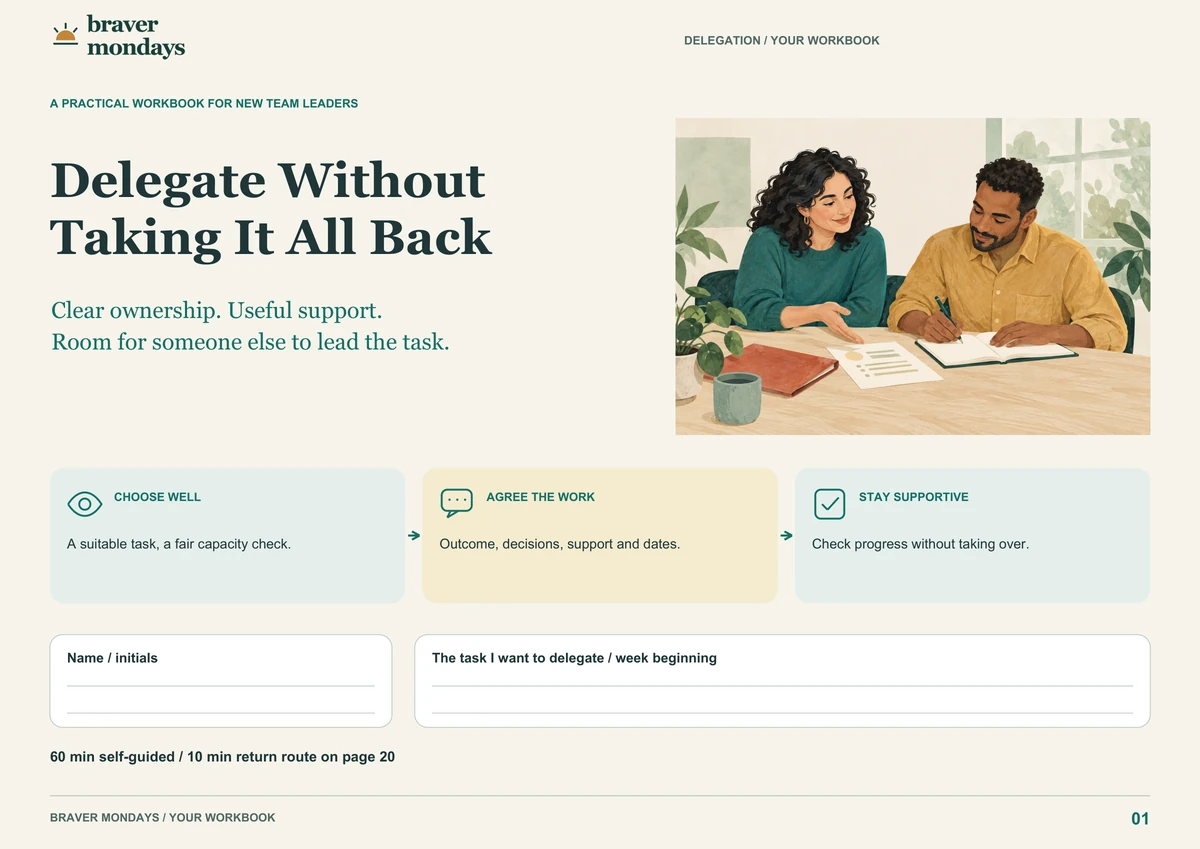
A CLEARER HAND-OFF STARTS ON ONE PAGE
Your delegation brief, decision boundaries and a check-in plan you can agree together.
THE FEELING YOU’RE WORKING TOWARD
“They know what
they own. I know
how to help.”
You can stay responsible without making every decision yourself.
- Choose a suitable task and check the person’s skills and capacity
- Explain what done means and which decisions they can make
- Agree support and checkpoints before the first obstacle
- Respond to questions without automatically reclaiming the task
Delegation takes preparation. The aim is clearer ownership and useful support, not an instant promise of fewer hours.
TRY ONE SMALL PART OF THE WORKBOOK
“Use your judgement”
needs a little more detail.
Maya asks Omar to prepare a project update. He owns the draft. But which decisions can he make?
Fictional example. Agree boundaries for the real task, authority and risk.
MAKE THE AGREEMENT EXPLICIT
01Omar decides within the brief.
“Choose a layout that makes the three milestone statuses, main risk and action owners easy to scan.”
The required content stays clear. The leader’s favourite layout does not have to be the only acceptable one.
In your workbook: name the decision, the limits and who approves.
LESS GUESSING. A BETTER AGREEMENT.
Make the hand-off
something you can see.
Visual exercises, an example from start to finish and three realistic practice cases. Build a brief for one task you are ready to delegate.
ONE TASK. A MORE CONFIDENT HAND-OFF.
Choose well.
Explain clearly.
Support the next step.
About 60 minutes working independently on your first pass.
A 10-minute brief-preparation route to reuse.
- 01
Check the fit before you assign
Choose work you can delegate. Discuss capability, capacity and what needs to move so the task can fit.
- 02
Give ownership something concrete
Define the result, decision rights, resources and deadline. Rehearse a conversation that invites questions.
- 03
Help without quietly taking over
Agree evidence for check-ins, respond to obstacles and review the finished work against the criteria.
WHEN THE WORK COMES BACK WITH A QUESTION
“What is blocking progress? I can help with the missing input. What part can you continue while I arrange it?”
You’ll practise the difference between helping with a gap and taking the whole task back.
INSIDE THE FULL WORKBOOK
Clear ownership. A useful way to stay involved.
Delegate Without Taking It All Back
- 01
Build a brief someone can use
Check task fit and capacity. Define the result, deadline and decisions the other person can make.
- 02
Practise the hand-off and check-in
Use a worked brief and three rehearsal cases. Try responding to an obstacle without automatically reclaiming the task.
- 03
Keep ownership and support clear
Reuse your delegation brief, check-in plan and completion review. Agree when to help and what stays with the other person.
A guide to work through it
Your 20-page visual workbook comes with a 10-page companion guide: teaching explanations, practice guidance and an optional 90-minute plan for practising with a group.
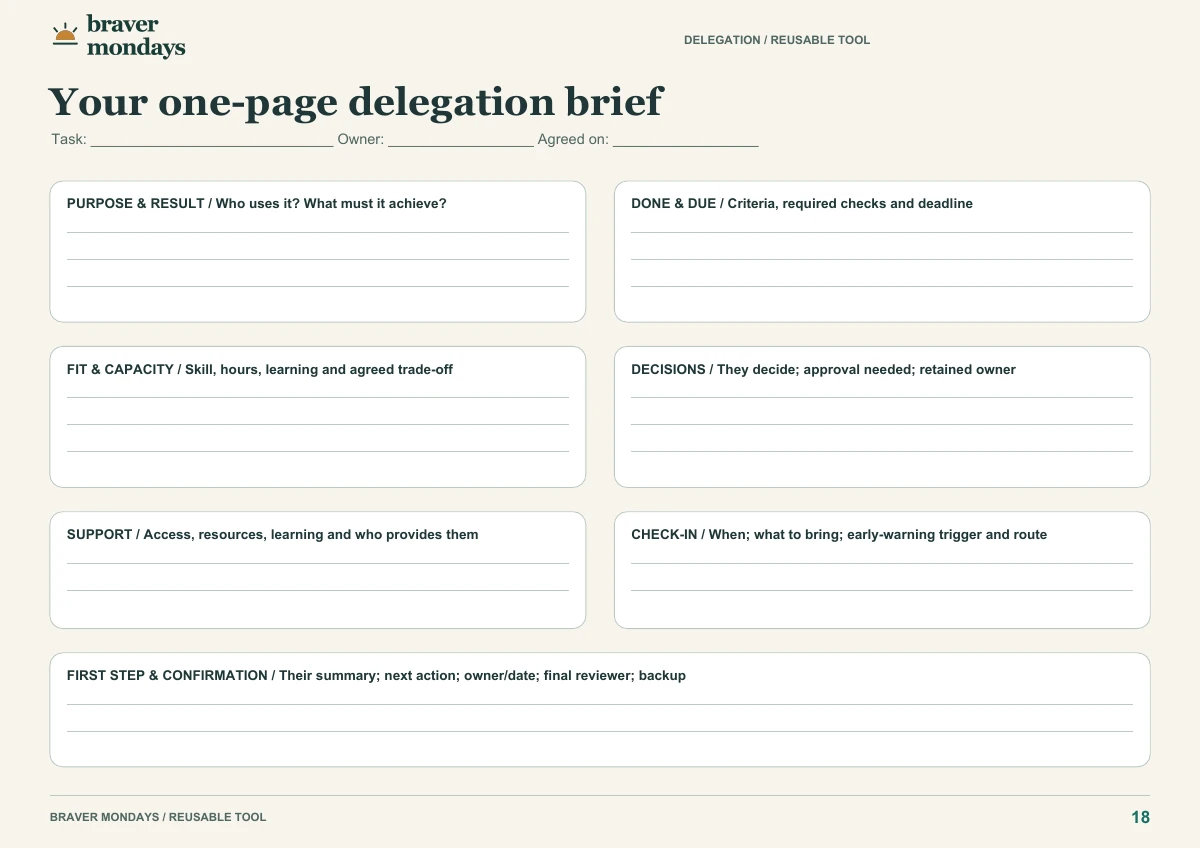
ONE COMPLETE WORKBOOK
Free sampleFull workbook in development
Bring one real situation.
Work through it at your pace.
- Two printable PDFs to keep and reuse
- About 60 minutes working independently on your first pass
- 10-minute brief-preparation return route
No payment now. Joining is not an order.
BEFORE YOU BEGIN
A few useful
details.
What does the workbook add to a template?
You work through explanations and a realistic example, make decisions for your own situation, rehearse the conversation and check your approach against the guidance. The reusable worksheet brings those decisions together.
Is this for a first-time team leader?
Yes. It is designed for everyday tasks you are authorised to delegate, especially when you are used to doing the work yourself. Start with a small, bounded task or use the fictional case.
Does delegation mean leaving someone to figure it out?
No. You will agree the result, decision boundaries, resources, learning support and checkpoints. You still own the responsibilities and approvals your role requires.
What if the team is already at capacity?
The workbook starts with that check. You will identify what would need to change in scope, timing or existing commitments before adding the work. Delegation should not simply move overload to someone else.
Should I never take a task back?
Sometimes intervention or reassignment is necessary. The exercises help you distinguish a preference from a quality gap or material risk, then make any change to ownership explicit.
Is it a live session or video course?
No. It is a self-guided workbook: a visual workbook and a companion guide as printable PDFs. Work through it on your own in about 60 minutes. There are no video lessons or live sessions: you get the material to keep. The guide also includes an optional 90-minute plan if you want to practise with a group.
Do I need either of the other workbooks first?
No. This workbook stands on its own, including a capacity check and a hand-off script. The conversation and workweek workbooks explore their own topics in more depth.
How do I complete the exercises?
Print the pages, use your PDF annotation tool or write separately. These are writing spaces rather than interactive form fields. Use fictional names and keep your completed notes private.
Can I buy it now?
We’re collecting interest before opening sales. Request 3 free samples, or join the launch waitlist for the workbook you want. No payment is collected and joining is not a pre-order.
CLEAR OWNERSHIP. USEFUL SUPPORT.
Give them the next step.
Know how you’ll help.
Start with one suitable task and an agreement you can both use.